


As a reliable supplier of CNC Closed Type Turret Punch Presses, I understand the critical role that punching force adjustment plays in the performance of these machines. In this blog post, I'll delve into the various punching force adjustment methods used in CNC Closed Type Turret Punch Presses, shedding light on their principles, advantages, and application scenarios.
Importance of Punching Force Adjustment
Before discussing the adjustment methods, let's first understand why punching force adjustment is so important. In the metal punching process, different materials have different physical properties, such as hardness, thickness, and ductility. Using an inappropriate punching force can lead to a series of problems. If the punching force is too small, the punch may fail to pierce through the material, resulting in incomplete punching or rough edges. On the other hand, if the punching force is too large, it can cause excessive wear on the mold, increase energy consumption, and even damage the machine structure. Therefore, accurately adjusting the punching force according to the material and process requirements is essential for ensuring high - quality punching results, prolonging the service life of molds and machines, and improving production efficiency.
Mechanical Adjustment Method
The mechanical adjustment method is one of the traditional ways to adjust the punching force in CNC Closed Type Turret Punch Presses. This method typically relies on mechanical structures such as springs, levers, or cam mechanisms.
Spring - based Adjustment
In spring - based adjustment systems, the punching force is adjusted by changing the pre - compression amount of the springs. Springs are used to store and release energy during the punching process. By adjusting the compression degree of the springs, the amount of energy available for punching can be changed. For example, if we want to increase the punching force, we can tighten the bolts that compress the springs, increasing the spring's pre - compression force. When the punch strikes the material, the springs release more energy, resulting in a greater punching force.
The advantage of spring - based adjustment is its simplicity and low cost. It is easy to understand and operate, and the mechanical structure is relatively simple, which reduces the probability of failure. However, it also has some limitations. The adjustment accuracy is relatively low, because the spring's elastic coefficient may change over time due to factors such as fatigue and temperature. And the adjustment range is limited, which may not be suitable for punching materials with a wide range of thickness and hardness.
Lever and Cam Mechanisms
Lever and cam mechanisms are also used to adjust the punching force in some CNC Closed Type Turret Punch Presses. The lever can amplify or reduce the input force according to the principle of leverage, and the cam mechanism can convert the rotary motion into linear motion with a specific force - displacement relationship. By changing the position or shape of the cam or the length ratio of the lever, the punching force can be adjusted.
These mechanical mechanisms offer a certain degree of flexibility in force adjustment. They can be designed to meet specific process requirements. But similar to spring - based adjustment, they also have drawbacks in terms of adjustment accuracy and range. Moreover, the manufacturing and maintenance of these complex mechanical parts require high precision and technical skills, which increases the cost and difficulty of machine maintenance.
Hydraulic Adjustment Method
The hydraulic adjustment method is widely used in modern CNC Closed Type Turret Punch Presses due to its high accuracy, large adjustment range, and good controllability.
Principle of Hydraulic Adjustment
In a hydraulic punching force adjustment system, hydraulic oil is used as the working medium. The system consists of a hydraulic pump, hydraulic cylinders, valves, and a control system. The hydraulic pump supplies high - pressure oil to the hydraulic cylinders. By adjusting the opening and closing of the valves, the pressure and flow rate of the hydraulic oil entering the cylinders can be controlled, thereby adjusting the output force of the cylinders, which is the punching force.
For example, when the control system detects that a larger punching force is required, it can increase the opening degree of the pressure - regulating valve, allowing more high - pressure oil to enter the hydraulic cylinder. As a result, the pressure in the cylinder rises, and the punching force increases. Conversely, if a smaller punching force is needed, the pressure - regulating valve can be adjusted to reduce the oil pressure in the cylinder.
Advantages of Hydraulic Adjustment
One of the main advantages of the hydraulic adjustment method is its high adjustment accuracy. The hydraulic system can accurately control the pressure and flow rate of the hydraulic oil through the use of precision valves and sensors, ensuring that the punching force can be adjusted to the exact value required by the process. This is particularly important for punching thin - walled or high - precision parts.
Another advantage is the large adjustment range. Hydraulic systems can generate a wide range of punching forces, from a few kilonewtons to hundreds of kilonewtons, which can meet the punching requirements of various materials and thicknesses. In addition, the hydraulic system has good dynamic performance. It can quickly respond to the control commands and adjust the punching force in real - time during the punching process, improving the production efficiency and quality.
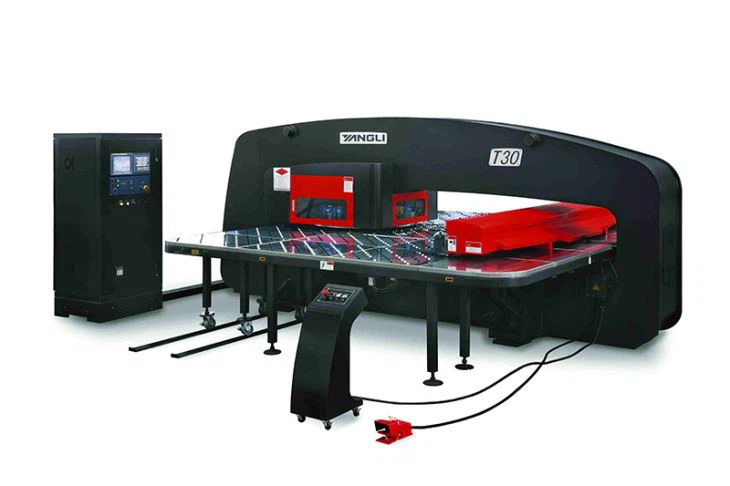
Our T30 Series Hydraulic Turret Punch Press and MP10 Series Hydraulic Turret Punch Press both adopt advanced hydraulic adjustment technology, which can provide stable and accurate punching force adjustment for different punching tasks.
Servo Adjustment Method
The servo adjustment method is a relatively new and advanced punching force adjustment technology, which combines servo motors and control systems.
Working Principle
In a servo - adjusted punching system, a servo motor is used to drive the punching mechanism. The control system can precisely control the rotation speed, torque, and position of the servo motor according to the set punching force parameters. By adjusting the output torque of the servo motor, the punching force can be accurately adjusted.
For instance, when the control system receives the punching force requirement, it calculates the corresponding torque value for the servo motor. Then, it sends control signals to the servo motor to adjust its torque output. During the punching process, the control system continuously monitors the actual punching force through sensors and makes real - time adjustments to the servo motor to ensure that the punching force remains stable and accurate.
Benefits of Servo Adjustment
The servo adjustment method offers several significant benefits. Firstly, it has extremely high adjustment accuracy. The servo motor can achieve precise torque control with an accuracy of up to ±0.1% or even higher. This high - precision adjustment is very suitable for punching high - value - added products with strict quality requirements.
Secondly, the servo adjustment system has fast response speed. It can quickly adjust the punching force according to changes in the process requirements or material properties, which is beneficial for improving the production efficiency and adaptability of the machine. Moreover, the servo system is more energy - efficient compared to hydraulic systems. It only consumes energy when punching, and can recover and reuse energy during the return stroke, reducing energy consumption and operating costs.
Our EP20/EP30 Series Servo Drive Turret Punch Press is equipped with a state - of - the - art servo adjustment system, which provides users with a more precise, efficient, and energy - saving punching solution.
Considerations for Punching Force Adjustment
When adjusting the punching force of a CNC Closed Type Turret Punch Press, several factors need to be considered.
Material Properties
The hardness, thickness, and ductility of the material are the main factors affecting the punching force. Harder materials generally require a larger punching force, while thinner materials need a relatively smaller punching force. For example, punching stainless steel requires a greater force than punching aluminum alloy of the same thickness. Therefore, before punching, it is necessary to accurately understand the material properties and select the appropriate punching force adjustment method and parameters.
Mold Design
The design and condition of the mold also have a significant impact on the punching force. A well - designed mold can reduce the punching force required. For example, a mold with a proper cutting edge angle and clearance can improve the punching efficiency and reduce the force needed. In addition, a damaged or worn - out mold may increase the punching force requirements and affect the punching quality. Therefore, regular inspection and maintenance of the mold are necessary to ensure its normal operation.
Process Requirements
Different punching processes, such as single - hole punching, continuous punching, and forming punching, have different requirements for punching force. For example, forming punching usually requires a larger punching force than single - hole punching because it involves deforming the material. Therefore, the punching force should be adjusted according to the specific process requirements to ensure the quality and efficiency of the punching process.
Conclusion
In conclusion, the punching force adjustment of a CNC Closed Type Turret Punch Press is a crucial aspect of ensuring high - quality punching results, prolonging the service life of molds and machines, and improving production efficiency. There are several adjustment methods available, including mechanical, hydraulic, and servo adjustment methods, each with its own advantages and application scenarios.
As a professional supplier of CNC Closed Type Turret Punch Presses, we are committed to providing our customers with high - performance machines equipped with advanced punching force adjustment technologies. Whether you need a machine for small - scale production or large - scale industrial manufacturing, we have the right solution for you.
If you are interested in our products or have any questions about punching force adjustment or other aspects of CNC Closed Type Turret Punch Presses, please feel free to contact us for further discussion and procurement negotiation. We are looking forward to working with you to achieve your production goals.

References
- "CNC Machine Tool Technology" by John Doe.
- "Punching Process and Equipment" published by ABC Press.


